Nothing to Shout About
A journey around the present question.
5/11/20266 min read
Nothing to shout about
I’ve been sitting with a question lately, one that arrived quietly while watching a film about horses and the people whose lives they have touched. The film moved me in places. In others it left me unsettled, though I’ve taken a while to understand why.
It was something about the word presence. The way it was used — freely, certainly, as though it were a place you could arrive at and know you had arrived. I’m fully present. The horse is fully present. We are fully present together. And I found myself wondering — is that what presence is? Is that what’s happening here?
Not a criticism. More a genuine question that sent me back through my own journey. As a psychotherapist, as someone who has spent time with horses, as someone who was once just as certain about these things as anyone in that film.
This is where that wondering led me.
To be fully present the ‘I’ who I think I am would have to leave. Or perhaps be absorbed, integrated, surrendered.
Surrendered, like the wind that doesn’t announce itself, the mountain that doesn’t know it’s still, the bird that doesn’t count its own silence.
I wonder if that part of me, so certain, is already watching from the doorway. Maybe proud of how far into the room ‘their’ presence has walked.
Though presence has no witness. No scorecard. There’s no one leaning over to report back. How can there be when there’s no separation?
I’ve discovered that presence isn’t about paying attention really well. It’s not something learned or practiced. What many of us describe as ‘fully present’ might be closer to mindfulness — noticing distraction, developing a quieter mind, feeling a heart connection. Real and valuable, but perhaps not the same thing.
I know this from the inside. Training as a psychotherapist we practiced exercises to build our capacity to hold space — the ‘now I am aware of’ game; moving attention between internal and external states, extending the time in awareness. We called it developing presence. Though really it was developing awareness. The word presence used as though it were something to achieve. The map quietly parting from the territory.
The deeper work, I came to understand, was about noticing the gap — the gap in awareness and understanding, becoming conscious of my conditioning, waking up to what I hadn’t seen. Not arriving somewhere. Just noticing where I actually am. More importantly, where I’m coming from, which may be from the parts still asleep.
Presence, it seems to me, is the true intimacy. Emahó called it uncaused light.
There is a word for what I’m pointing at — non-duality. The simple, radical recognition that there was never a separation to overcome. No gap between self and world, between you and the horse in the field, between the observer and the observed. Just this, undivided. The ‘I’ who thinks it can achieve presence is itself the obstacle — not because the ego is the enemy, but because asleep it mistakes itself for the whole.
And yet the ego has its place. Awake, it knows what it is — a function, a vehicle, a way of moving through the world. It can write this essay, hold a therapy space, feel the reins. But it doesn’t confuse itself with the centre of the universe. Awake ego responds. Asleep ego manages.
The difference between those two words is everything.
In Fight Club there is a scene where a car is driven at speed and the wheel is released. Not peacefully. In terror. The point being — you cannot control everything and be fully alive. Something has to be surrendered. In The Last of the Mohicans a woman steps from a cliff rather than be taken. The ego would do anything to survive. She steps past it entirely. That is not defeat. That is a fierce and terrible freedom. Malick’s Thin Red Line asks the same question differently — what is this war in the heart of nature? Men clutching, men releasing, the grass indifferent and beautiful.
None of this is flowers and sugar.
Real presence — non-dual presence — isn’t the warm feeling in the field. It may be closer to the moment just before the jump. The hands leaving the wheel. The response that moves through you before thought arrives.
When we truly surrender to the understanding that we are not separate — from each other, from the horse, from the life moving through all things — the world reorganises. Not because it changed. Because the one who was standing apart from it, managing it, narrating it, briefly wasn’t. And in that space something responds that is wiser and older than the ego’s best efforts.
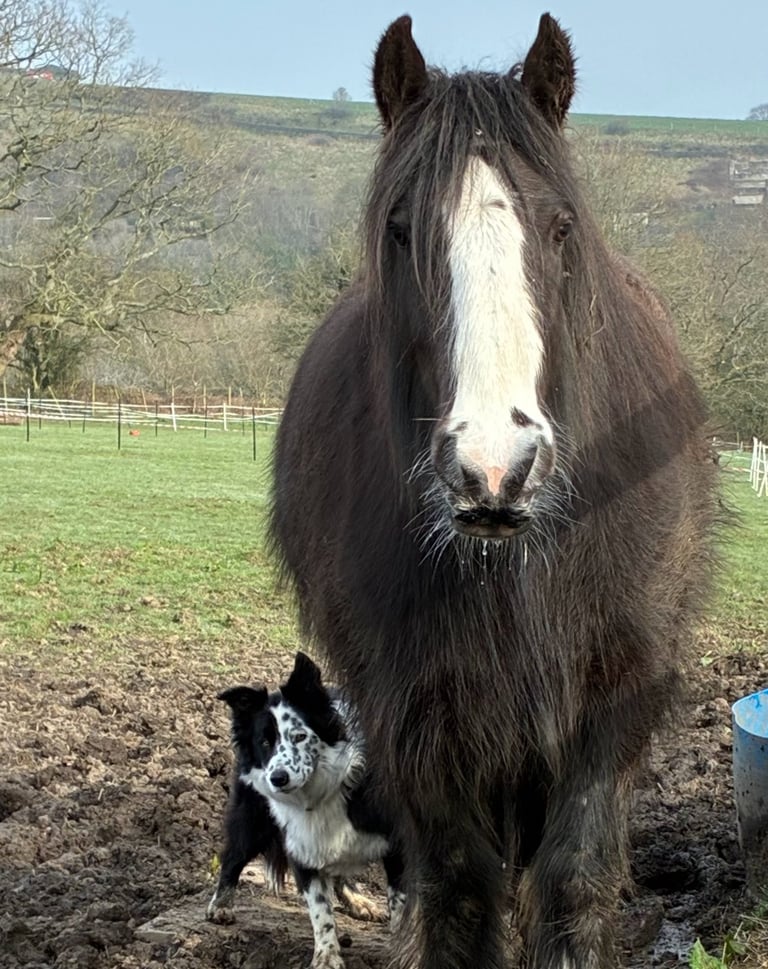
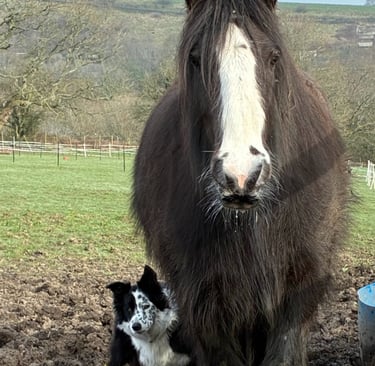
I’m curious about what horses know of this — if anything. They aren’t fully present either — not in any philosophical sense. My experience of them is that they are just completely themselves, which feels like something else entirely. They don’t rationalise, project, or assign meaning. Horse as healer, horse as mirror, horse as therapist — these are our roads to connection, not theirs. That’s our language, our longing, our gap.
The horse lives in response without management. Presence without announcement. Just as itself, completely, in every moment.
The horse’s survival and its wholeness are the same thing. It stays alive by belonging — to the herd, the field, the wind, the approaching storm. There is no separation between surviving and being fully, completely itself. No gap between the animal and its world.
Human ego survival works differently. It survives by separating — defining, defending, controlling, narrating. Building walls and calling them identity. Gripping the wheel. And in doing so, cuts itself off from the very aliveness it is trying to protect.
This is what Brad Pitt’s character was pointing at in that car. Not recklessness. Not nihilism. But something more honest — your grip is the thing that’s killing you. Let go and discover what’s actually here.
The horse never gripped the wheel. It doesn’t know how. And we stand next to it and feel, just for a moment, what it might be like to live that way. Not as spiritual achievement. As biological truth.
For the horse, connection could simply be life. Together we thrive. There is no gap between the feeling and the function. I wonder if somewhere in becoming so extraordinarily capable — the rationalising, the meaning-making, the self-awareness — we buried that simple animal knowing. We can think about connection, talk about connection, build entire frameworks around it. And yet somehow remain unreachable to ourselves.
Though loneliness and aloneness are not the same thing. Loneliness is the gap unfelt, unacknowledged — the reaching, the projecting, the meaning we assign to other beings to carry what is ours to carry. Aloneness is something we might move toward, not away from. When we can truly sit with our own aloneness — not fix it, not fill it — something shifts. We begin to build a life from solid ground. And from there, no one is truly alone. Not when they are fully, honestly alive.
So when we find ourselves with a horse — perhaps for the first time, perhaps as if for the first time — and the tears come, it feels like grief and relief. Not for something that happened. But for something buried underneath the weight of everything we’ve learned, achieved, become. We didn’t know it was there until, suddenly, it invites itself into the space we are given. The feeling of return inseparable from the feeling of how long we’ve been away.
Uncaused light doesn’t flicker to show us it’s burning. Just as we cannot be fully of something we were never separate from.
The horse is just here. And I wonder if that’s why it feels so powerful. It’s so true and we recognise that.
But if we looked honestly at the gap — really sat with what we’re carrying, what we’re seeking, what we’ve buried — it seems to me we might walk into that field differently. Not to be healed. Not to forge connection. Not to make sense of it or disappear into analysis. Just two beings, each completely themselves.
And I find myself asking how we could hold a being we call healer, mirror, teacher — in a pen, in ropes, in tack, with whips softened by prettier names. Waiting to go to work.
The spiritual language doesn’t change any of this. I wonder if we could simply let go and release the need to dress it up.
When something real does happen — when we meet the horse on their terms and the distance closes — we find ourselves somewhere unremarkable, unannounced, undefinable. No certificate for it. No name that fits.
Horses are just horses. Humans are just humans. We live the lives given even when we don’t know it.